
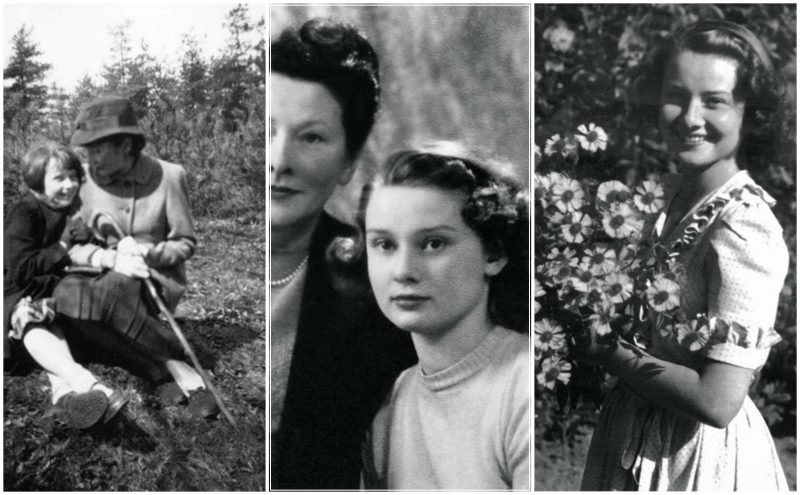
Audrey Hepburn is remembered as one of the most gracious and compassionate figures in Hollywood history. She was an Oscar-winning actress, a fashion icon, and a dedicated UNICEF ambassador. But behind that image was a complicated family story — and at the center of it was a man most people have never heard of.
Joseph Victor Anthony Ruston was Audrey Hepburn’s father. He left the family when she was just six years old, was later interned during World War II for fascist sympathies, and spent decades estranged from his famous daughter. Understanding who he was helps explain a lot about the woman Audrey became.
Who Was Joseph Victor Anthony Ruston?
Joseph Victor Anthony Ruston was born in 1889 in Úžice, a small town in Bohemia, which was then part of the Austro-Hungarian Empire. Despite being born in Central Europe, he was a British subject by nationality.
His father, Victor John George Ruston, was English. His mother, Anna Wels, was of German-Austrian descent. That mixed background gave Joseph a complicated identity from the start — British by law, but rooted in the heart of Europe.
Genealogical records, including entries on MyHeritage and Find A Grave, list him under two versions of his name: Joseph Victor Anthony Ruston and Joseph Victor Anthony Hepburn-Ruston. He died in 1980 in Ireland, at around age 90.
Most people who search for his name today are trying to understand Audrey Hepburn’s family origins. He is, above all else, known as her father.
The Hepburn-Ruston Name and the Ancestry Claim
Joseph was born with the plain surname Ruston. At some point, he adopted the double-barrelled name Hepburn-Ruston. The reason he gave was that he believed himself to be descended from James Hepburn, the fourth Earl of Bothwell — the third husband of Mary, Queen of Scots.
It sounds impressive. But genealogists and biographers who have looked into the claim have found no confirmed Hepburn line in his documented family tree. One piece of family lore references a maternal great-grandmother named Hepburn, but this has never been verified.
The name change appears to have been more about image than ancestry. Joseph seems to have wanted a more aristocratic-sounding surname. This is not unusual in European family histories — romantic claims of noble descent often circulate for generations without solid proof behind them.
It is important to be clear: the Hepburn ancestry claim is family lore, not an established genealogical fact.
His Career — Diplomat, Banker, or Neither?
Depending on which source you read, Joseph Ruston was a banker, a businessman, an importer, or a minor diplomat. The descriptions vary, and none of them are fully consistent with each other.
One concrete role that does appear in multiple sources is his appointment as Honorary British Consul in Semarang, in the Dutch East Indies, in the early 1920s. That is a real consular post, though not a senior diplomatic position. He also worked for a trading company and a loan company at various points in his life.
Encyclopedia.com describes him as an “Anglo-Irish banker and importer.” Some biographers have used the cleaner label of “banker” to describe him. But Audrey Hepburn herself told a different story.
According to biographical accounts, Audrey said that her father never managed to hold down a job. That directly contradicts the polished image found in some sources. The honest picture of his career is patchwork — a series of roles that never quite added up to a stable profession.
His Fascist Affiliations and Wartime Internment
This part of Joseph Ruston’s story is the most historically significant — and the most jarring when held up against his daughter’s later legacy.
British archival records at the National Archives confirm that he was an active member of the British Union of Fascists, commonly known as the BUF or the Blackshirts, from 1934 to 1936. The BUF was founded by Oswald Mosley and openly admired Adolf Hitler’s rise in Germany.
When World War II began, British authorities acted quickly to detain individuals they believed posed a security risk. Joseph was interned under Defence Regulation 18B — a wartime law used to hold suspected Nazi sympathizers — from June 1940 to April 1945. That is nearly five years of detention.
Some biographical accounts describe him as expressing what one writer called “unqualified enthusiasm for Hitler.” He was not a fringe figure quietly sympathizing from a distance — he was an active participant in a fascist organization during a period when that movement was causing real harm across Europe.
The contrast with his daughter’s later life is striking. Audrey Hepburn spent her final years traveling the world as a UNICEF Goodwill Ambassador, visiting children in some of the poorest and most war-torn places on Earth. Her father had spent his earlier years aligned with the very ideology that devastated so many of those communities.
Two Marriages and the Family He Left Behind
Joseph was married twice. His first marriage was to Cornelia Bisschop, described as a Dutch heiress. That marriage ended before he met Audrey’s mother.
His second wife was Baroness Ella van Heemstra, a Dutch aristocrat with connections to the Dutch royal family. Audrey was born in 1929 in Ixelles, Belgium — the only child of Joseph and Ella.
Audrey was registered at birth as Audrey Kathleen Ruston. She later used the fuller form Edda van Heemstra Hepburn-Ruston, particularly during the war years in German-occupied Holland, when having an English name could be dangerous.
The marriage between Joseph and Ella did not last. Around 1935, when Audrey was approximately six years old, her father left. By most accounts, he simply disappeared from her daily life. Audrey later recalled that her mother told her he had “gone away on a trip” and might not come back.
She saw him briefly in 1939. When Britain declared war on Germany, Joseph put Audrey on a plane to Holland to be with her mother’s family. After that, they did not meet again for over twenty years.
The Estrangement and the Later Reconnection
For Audrey, her father’s disappearance left a lasting mark. Biographers and people who knew her describe the abandonment as one of the defining experiences of her life. It is connected, in many accounts, to her shyness, her deep need for security, and her powerful empathy for vulnerable people — especially children.
Despite everything, Audrey did eventually reconnect with her father in adulthood. She made efforts to support him, both financially and emotionally, in his later years. The relationship remained complicated, shaped by decades of distance and pain. But she did not cut him off entirely.
He died in Ireland in 1980. Audrey died in 1993. The full story of their later relationship is not well-documented, and it would be wrong to speculate beyond what sources confirm. What is known is that Audrey chose connection over bitterness — which, for many readers, says everything about her character.
What His Background Tells Us About Audrey Hepburn
Joseph Victor Anthony Ruston was a complicated man. He came from a mixed European background, claimed an aristocratic lineage he probably couldn’t prove, drifted through jobs without much stability, aligned himself with a fascist movement, and abandoned his daughter before her seventh birthday.
None of that defines Audrey Hepburn. But it does give context to who she was and where she came from. She grew up without the father who had given her his surname, in a continent torn apart by a war that his political allies had helped start. She lived through German occupation in Holland as a child. She watched people suffer.
For those who want to understand Audrey more fully, learning about Joseph is part of that picture. Firstbusinesspoint covers profiles and background stories across business and celebrity topics for readers who want the full story, not just the highlights.
Through his heritage, Audrey was British. Through her mother, she was Dutch. She was born in Belgium and raised across Europe. Joseph’s side of the family tree included English, Czech, and possibly other roots, according to genealogical analysis. That layered identity contributed to the woman the world came to admire.
A Name Worth Knowing
Joseph Victor Anthony Ruston is not a famous man. He left no great legacy of his own. His name appears mostly in footnotes, genealogical databases, and the opening chapters of Audrey Hepburn biographies.
But understanding him matters. He is the reason Audrey carried the name Ruston. He is part of why her childhood was unstable. His political choices place a shadow near her otherwise radiant story. And his eventual reconnection with his daughter — however incomplete — is a quiet thread in a life that was far more complex than the elegant image on the screen.
Audrey Hepburn’s grace was not inherited from her father. If anything, it seems to have been built in spite of him.
Read Also: