
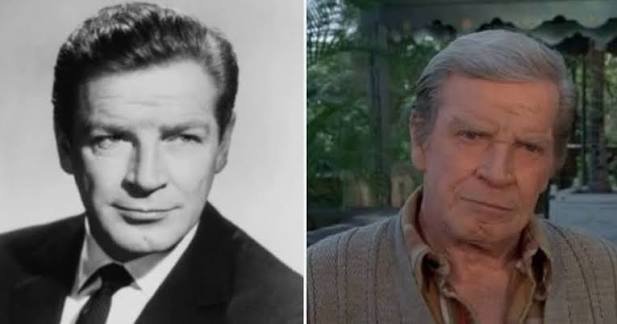
Richard Basehart spent nearly five decades working across stage, film, and television. He never chased celebrity in the traditional Hollywood sense, but he earned something rarer — consistent respect from peers, critics, and audiences alike.
This article covers his Ohio roots and family background, his path from radio announcer to Broadway and then Hollywood, his most recognized roles, his personal life, and why his name still comes up in film history discussions and genealogy searches today.
From Zanesville, Ohio, to the Stage
Richard Basehart’s full name was John Richard Basehart. He was born on August 31, 1914, in Zanesville, Ohio. Most major biographical sources, including his New York Times obituary, use that date, though a small number of sources note August 14 as an alternative.
His parents were Mae and Harry T. Basehart. His father had tried acting earlier in life before becoming a newspaper editor in Zanesville. That background put Richard close to both storytelling and the press from an early age.
Before he ever set foot on a stage professionally, he worked as a reporter at his father’s newspaper and as a radio announcer in Ohio. Those jobs gave him a sense of pacing, voice, and how to hold an audience’s attention — skills that would serve him well for the rest of his life.
His early stage work took place at the Hedgerow Theater in Pennsylvania, a respected regional company. He made his Broadway debut in 1938, and it took only a few years for a breakthrough to arrive. In 1945, he won the New York Drama Critics Circle Award for his role in The Hasty Heart, playing a dour Scottish soldier. That recognition opened the door to Hollywood.
His Film Career and the Role That Earned International Respect
Basehart made his film debut around 1947 in Cry Wolf. A year later, he appeared in He Walked by Night (1948), a gritty crime noir that put him on the map as a serious screen presence. The film is still cited by critics as an important entry in the noir genre.
But the role that brought him genuine international attention came in 1954. Italian director Federico Fellini cast him as “the Fool,” a gentle traveling acrobat, in La Strada. The film won the Academy Award for Best Foreign Language Film and is widely considered one of the great works of Italian cinema. Basehart’s performance was praised for its warmth and restraint.
He also appeared in Moby Dick in 1956, alongside Gregory Peck. Throughout the 1950s, he moved fluidly between American and European productions, which was not common for actors of his era.
Critics and colleagues tended to describe him as a serious character actor rather than a conventional leading man. He was not a matinee idol type, and he seemed uninterested in being one. His reputation was built on range and consistency rather than star power or box office pull.
Admiral Harriman Nelson and Television Fame
For many viewers, especially those who grew up in the 1960s or caught reruns later, Richard Basehart is best known for one television role: Admiral Harriman Nelson, commander of the nuclear submarine Seaview in Voyage to the Bottom of the Sea.
The series ran on ABC from 1964 to 1968. It was a science-fiction adventure show that became a genuine staple of its era, mixing underwater action with Cold War tension and fantastical plots. Basehart anchored the series as its lead, and the role introduced him to a broad general audience that may not have followed his film work.
Through syndication, the show reached new viewers long after its original run ended. That extended life is a big reason his name is still recognized by people who weren’t alive when the series first aired.
His television work went beyond that one series. He appeared in episodes of The Twilight Zone and Columbo, two programs that have never really gone away in terms of cultural visibility. He also appeared in the pilot episode of Knight Rider, playing Wilton Knight, the founder of Knight Industries — the man behind the talking car. It was a small but memorable role that introduced him to yet another generation of viewers.
Voice Work, the 1984 Olympics, and His Final Years
Basehart had a deep, resonant voice that made him a natural choice for narration. He worked steadily through the late 1970s and into the early 1980s across film, television, and stage, never really stepping away from the craft.
One of his final public contributions was narrating the closing ceremonies of the 1984 Summer Olympics in Los Angeles. It was a high-profile assignment, and his voice was well suited to the occasion.
Shortly after the Olympic narration, he suffered a series of strokes. He died on September 17, 1984, in Los Angeles. He was 70 years old.
Obituaries described him as an actor of distinguished bearing with a long and consistently productive career. The New York Times and UPI both covered his passing, noting the Olympic narration and his years in television and film. He holds a star on the Hollywood Walk of Fame.
Personal Life, Marriages, and the Animal Welfare Foundation He Left Behind
Basehart was married more than once. His most publicly documented marriage was to Italian actress Valentina Cortese, who was his second wife. Cortese was a significant figure in European cinema, and their relationship placed Basehart firmly within international film circles during the 1950s and 1960s. For anyone researching genealogical connections to Basehart, this marriage is worth noting, as it links American and Italian family lines.
He later married a woman named Diana. Together, the two of them founded Actors and Others for Animals in 1971, a nonprofit organization focused on preventing cruelty to animals. The organization still exists and remains part of his lasting public legacy in the Los Angeles entertainment community.
Public sources mention that Basehart had children, but specific names and details are limited in verified records. Anyone researching a potential family connection should look into local Ohio records, census entries, and newspaper archives related to the Basehart surname, rather than relying on unverified online claims.
If you have found Richard Basehart listed in a family tree on a genealogy platform, the connection most likely runs through shared ancestors in Zanesville or surrounding Ohio regions, or through extended family rather than direct descent. Cross-referencing public records is the safest way to trace any actual link. For research tools and resources that can help with that kind of background work, First Business Point offers a range of useful reference content.
Why His Name Still Surfaces Today
Basehart’s career covered a remarkable range. He went from a small-town Ohio newspaper to Broadway, from Broadway to Hollywood, from Hollywood to Italian art cinema, and from film back to television — where he reached his largest audience.
He was not the biggest star of his era, and he likely would not have claimed to be. But he was working at a high level across multiple decades and multiple formats, which is harder to do than it looks.
La Strada is still studied in film courses. Voyage to the Bottom of the Sea still has a dedicated fanbase. He Walked by Night still appears in noir retrospectives. And Knight Rider, thanks to streaming and nostalgia, keeps finding new viewers who occasionally look up who played the man who built KITT.
All of that adds up to a legacy that is quiet but durable. Richard Basehart worked seriously, lived relatively privately, gave generously through his animal welfare work, and left behind a body of work that holds up decades later. That is not a small thing.
Read Also: